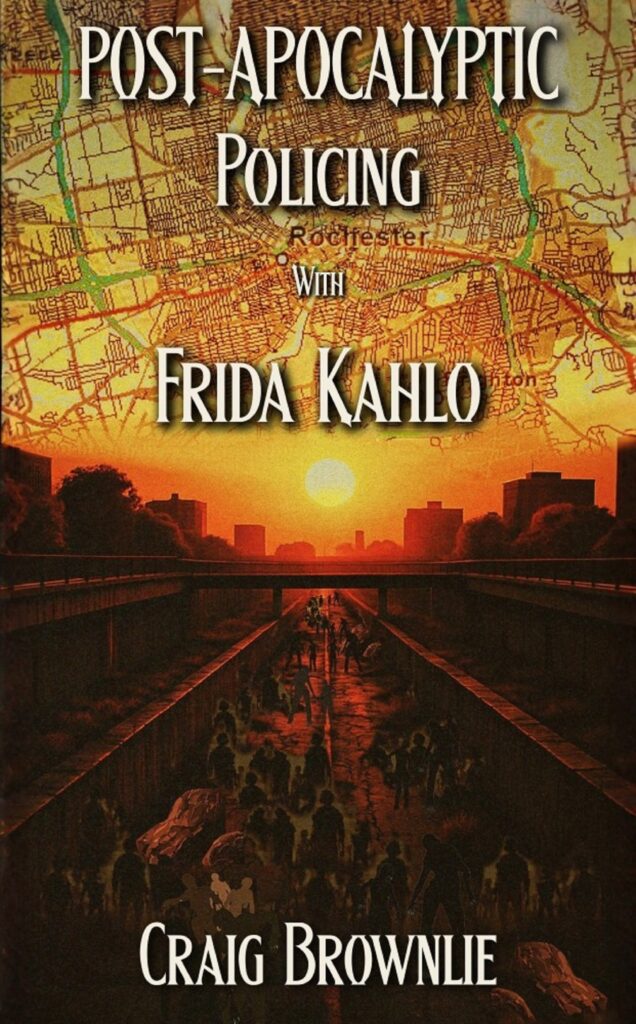
by Craig Brownlie ($16 paperback, $3.99 eBook)
Alonzo Crash survived the zombie apocalypse to be appointed police detective in a world where the victims re-animate and the perpetrators have done so much worse to survive than commit one murder.
Dashiell Hammett meets Brian Keene in a neo-detective noir that dares ask how you define murder after the zombie apocalypse.
A pulp detective story set in a late 50s science fiction zombie world with post-modern aspirations, but that may be overthinking it! An existential noir inside a post-apocalyptic pulp tale inside a post-modern zombie fright fest
“Equal parts psychedelia-fueled mystery and bizarro zombie siege, Post-Apocalyptic Policing with Frida Kahlo is a true tour-de-force from Craig Brownlie. He’s one to watch.” -Stephen Kozeniewski, “Man of Letters” as well as author of Braineater Jones and The Hematophages.
Enjoy an excerpt:
Two
I found myself on my bike heading to the South Wedge the next morning. The spring air blew off the sun-lit lake, which prevented me smelling the retention pens until I crossed over them. If you lived in the city, you could tolerate the stench to some extent.
Wearing a rebreather, Phil stood on the bridge over what used to be I-490. I don’t know how he did it every day, but the man hadn’t missed a shift in two years, though everyone knew why. Less inclined toward punctuality and reliability, I would have missed more than a few shifts. The word at the barracks had him taking all the shifts for the last few weeks. We all break in different ways in our own time.
After the end of the world, the phrase “Crazy Cat Lady” took on a more sinister meaning. Infestations became far more urgent. The issue used to be smell and clutter, not rumors about returning pets. The Mayor worried about widespread panic.
I pulled my kerchief over my face as I dismounted and walked the bike down the middle of the road. Most days I avoided looking over the edge of the bridge.
Gate guards had mostly stopped putting on full gear, but stagnant days came along when the smell proved too much for anyone to bear.
“Hey, how are they today?” I asked.
“Same old, same old, the way I like it.” Through the face mask, Phil’s voice sounded dim and round as if from a cave. His eyes shared a tunnel vision appearance with many of us.
“Any familiar faces?”
Soon as I spoke, I regretted it. Phil waved me over. I ambled toward him after putting the bike against a pile of rubble. I focused on the sky for a second before lowering my gaze.
Interstate 490 ran through the center of Rochester. Soon as it hit downtown, it shot a spur around the northern edge before joining back up with the main line at the end of the city. This once formed a large loop around downtown. Choosing the southern arc because the highway planners had dug it deep into the ground, survivors walled off and covered with fencing a large section of the loop.
Looking over the edge, a roof of chicken wire stretched into the distance. Beneath it, the zombies meandered. I tried to maintain my focus on the crosshatch no more than a feet beneath us, so I wouldn’t have to look at the walking cadavers. Survivors chose to keep these meandering dead, family or worth saving for another reason. I knew more about the latter since I had spent the first year of the plague hiding in a science lab at the University of Rochester. We experimented on the reanimated when not fighting for survival. No one fit the bill for me to keep.
Phil nudged me. He’d been talking while I tried to maintain my equilibrium.
“There’s my Becky,” said Phil.
I let my eyes focus where he pointed. Becky didn’t look as bad as others did.
“It rained overnight. They always look a little better after the rain, at least the ones who stay out of the mud.” Phil said.
“I have to head down to the Wedge. Can you let me out?”
Phil frowned.
About a year previous, we had extended the city protection to encompass the Wedge neighborhood, a dangling area south of the freeway. Most folks will not set foot outside the original downtown fences. Those barriers represented the difference between life and death for all of them. A couple hundred people moved to the reclaimed land, barely enough to justify the effort, but the city needed somewhere for new arrivals.
“You be careful out there,” said Phil.
“I will do my best.” I turned back to him. “I’ll see you on my way back over.”
“I’ll be counting the minutes.” The facemask disguised the degree of Phil’s sarcasm.